What Happens When Your Ball Is Out of Bounds?
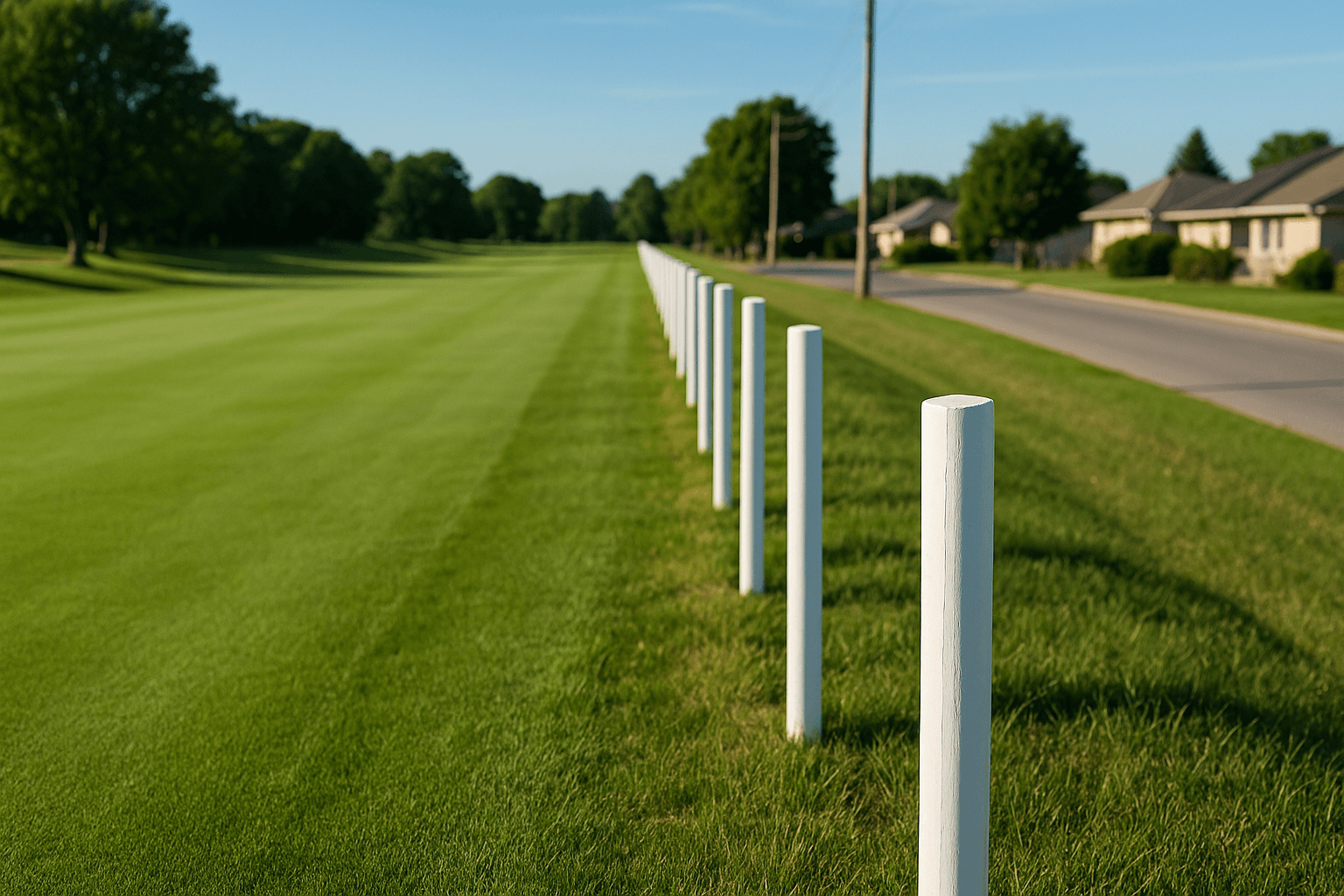
Yes, there is a penalty. If your ball is out of bounds — the entire ball past the white stakes or boundary line — you take a one-stroke penalty and must replay from the previous spot (Rule 18.2). You can avoid the walk back by hitting a provisional ball before you search, or, if the club has Local Rule E-5 active, drop near the boundary for two strokes instead.
What counts as out of bounds?
A ball is out of bounds only when all of it lies outside the boundary edge of the course (Rule 18.2a(2)). If any part of the ball touches the ground, a stake, or anything else inside the boundary edge — or even overhangs the edge — the ball is in bounds. White stakes and fence posts are themselves out of bounds; a ball that hits a white stake and bounces outside is OB.
You may stand out of bounds to play a ball that is in bounds.
The rule: stroke and distance
When your ball is OB (or lost after 3 minutes of search), the standard Rules of Golf require stroke-and-distance relief (Rule 18.2b):
- Return to the exact spot of your previous stroke.
- Drop a ball (knee height) within one club-length of that spot, no nearer the hole.
- Add one penalty stroke.
If your tee shot is OB, your next stroke is your third from the tee.
The provisional ball: play it before you search
Whenever there is a real chance your ball is OB or lost outside a penalty area, play a provisional ball before you go forward to search.
How to declare it correctly:
- Before leaving the previous spot, announce clearly: "I'm playing a provisional ball."
- Play from the same spot (or anywhere in the teeing area if the original was from the tee).
- You have 3 minutes to search once you reach the area.
- If you find the original in bounds, you must play it and abandon the provisional — no penalty.
- If the original is OB or not found in 3 minutes, the provisional becomes the ball in play with a one-stroke penalty.
Critical: If you do not declare it a provisional, the second ball automatically becomes the ball in play under stroke and distance, and you lose the right to search for the original (Rule 18.3b).
Local Rule E-5: the drop alternative
Many clubs adopt Model Local Rule E-5. When active, you may — instead of returning to the previous spot — drop a ball in the fairway within two club-lengths of the estimated point where the ball crossed the boundary (or where it was lost), no nearer the hole, for a two-stroke penalty.
This option is only available if the club has activated it in its Local Rules. Check the notice board or scorecard before you tee off. If E-5 is not in effect, stroke and distance is your only option.
Penalty summary
| Situation | Penalty |
|---|---|
| Standard Rule 18.2 (stroke and distance) | 1 stroke + replay from previous spot |
| Local Rule E-5 active (drop near boundary) | 2 strokes, no return to previous spot |
Tactical tips
- Play the provisional immediately when you suspect OB. The most costly amateur mistake: walking forward, confirming OB, then walking back to the tee — wasting time and adding frustration.
- On a tight driving hole, consider an iron off the tee to eliminate the OB risk entirely.
- If E-5 is active, note it on your scorecard so you don't forget under pressure.
What if your provisional ball is also lost or out of bounds?
You can play another provisional ball. Each provisional relates only to the ball played immediately before it (Rule 18.3a). If the second provisional is also lost or OB, you may play a third, and so on — but each must be played from a spot the same distance or farther from the hole than where the previous ball was estimated to be. If any provisional is played from a spot nearer the hole than the original ball's estimated position, that provisional becomes the ball in play under stroke and distance (Rule 18.3c(2)).
Keep reading: provisional ball
FAQ
Is a ball that touches the white line out of bounds?
No. The ball is only out of bounds when all of it is outside the boundary edge. If any part of the ball touches the white line, a white stake, or the ground inside the edge, it is in bounds (Rule 18.2a(2)).
Can I drop near where the ball crossed OB without playing a provisional?
Only if the club has Local Rule E-5 active. Without it, you must return to the previous spot under stroke and distance (Rule 18.2b).
What if I didn't see where the ball landed and can't find it?
If there is no certainty it is OB but you cannot find it within 3 minutes of search, it is lost (Rule 18.2a(1)). The penalty is the same: stroke and distance from the previous spot.
How long do I have to search for a ball that might be OB?
Exactly 3 minutes from the moment you (or your caddie) arrive at the area where the ball is estimated to be. Time spent walking to the area does not count.
Can I stand out of bounds to hit a ball that is in bounds?
Yes. Rule 18.2a(2) only looks at where the ball lies. You may stand anywhere — out of bounds, in a penalty area, even in water — as long as you do not move the ball or improve conditions affecting the stroke.
Do I have to announce "provisional ball" before I search?
Yes, and before you make the stroke. If you play a second ball without declaring it a provisional, that ball becomes the ball in play under stroke and distance, and the original is abandoned (Rule 18.3b).
Can I play a provisional ball after I've already started looking for my original?
Yes. You may play a provisional ball at any point until the three-minute search time ends, even if you've already walked forward and begun searching (Rule 18.3a, Interpretation 18.3a/2). If you find the original in bounds within the three minutes, you must abandon the provisional.
What exact words do I have to say when announcing a provisional ball?
You must use the word "provisional" or otherwise clearly indicate you're playing under Rule 18.3 (Rule 18.3b). Saying "I'm playing another" or "I'll hit again" is not enough. Acceptable: "I'm playing a provisional ball," "I'm playing a ball under Rule 18.3," or "I'm going to play another just in case."
If I play a provisional and then find my original ball in a penalty area, what happens?
You must abandon the provisional ball and continue with the original ball (Interpretation 18.3a/1). A provisional ball is only allowed when the original might be lost outside a penalty area or out of bounds. If the original is found in a penalty area, the provisional was not permitted and must be abandoned.
Does the three-minute search clock stop if play is suspended or I have to wait for another group?
Yes. Time when search is temporarily interrupted — for example, dangerous weather, a ruling, or waiting for the group ahead — does not count toward the three minutes (Interpretation 18.2a(1)/1). The clock resumes when you can reasonably continue searching.