Ball in a Tree: What to Do with an Unplayable Ball
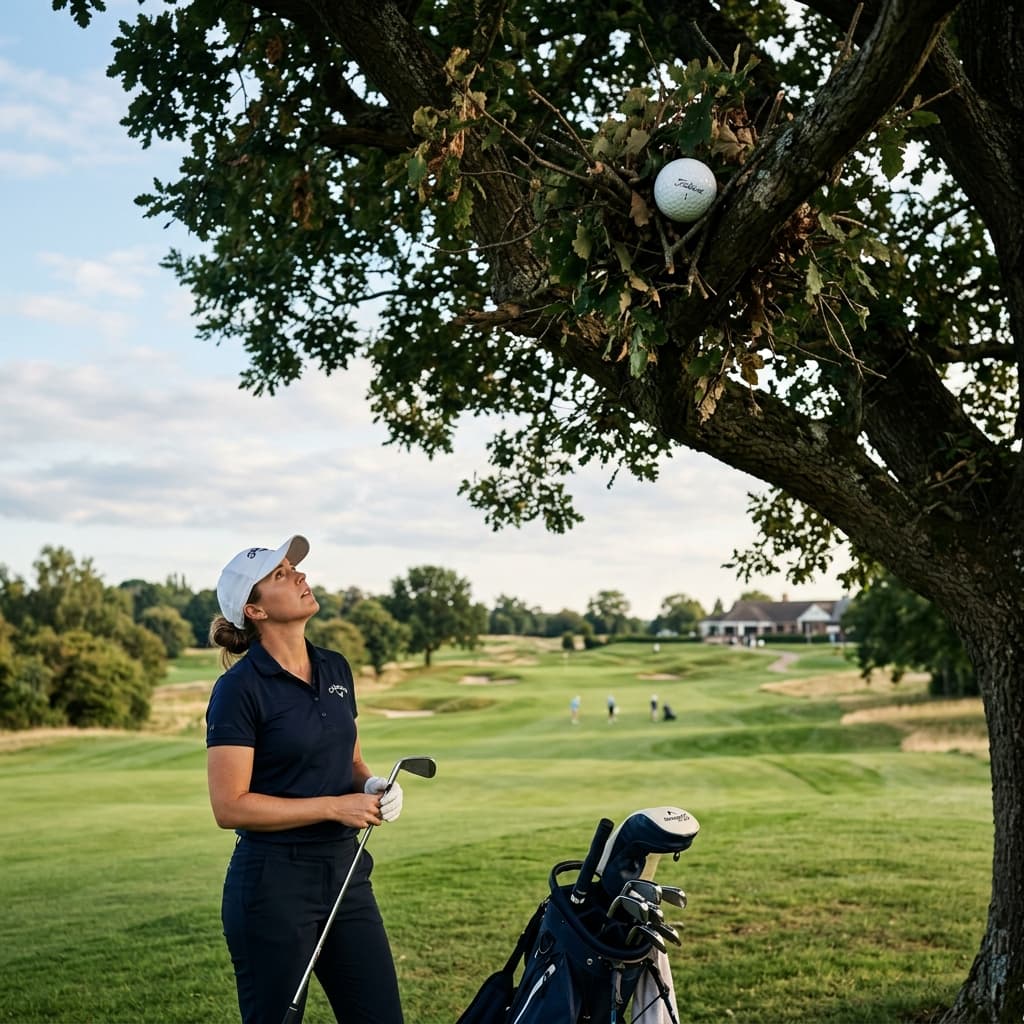
Yes, you can declare a ball stuck in a tree unplayable under Rule 19.2 for one penalty stroke and choose from three relief options — stroke and distance, back-on-the-line, or two club lengths from the spot on the ground directly below the ball.
The unplayable ball: basic principle
If your ball has ended up wedged in a tree — whether snagged in low branches just off the ground or lodged in the canopy several metres up — you are entitled to declare it unplayable under Rule 19.2. The three-option structure is the same as any unplayable lie, but the tree introduces a practical twist that trips up many players: the reference point for measuring your relief is always the spot on the ground directly below the ball, not the ball's actual height in the branches.
The player always decides whether to declare a ball unplayable — you don't need anyone's approval. The only exception is if the ball is in a penalty area: Rule 19 does not apply there.
The cost is 1 penalty stroke in all cases. In return, you have three relief options.
The three options under Rule 19.2
Option 1 — Stroke and distance
Return to the exact spot where you played the previous stroke and play from there (+1 stroke).
This is the most costly option tactically because you might go back several strokes' worth of progress, but it guarantees you play from a reasonable position. For a tee shot that ended up in a tree near the green, it is the worst option.
Option 2 — Back-on-the-line relief
Draw an imaginary line from the hole through the point where the ball lies (in the tree, at its estimated position on the ground directly below). You may drop anywhere on that line, as far back as you like — but with no lateral room, you must stay on the line (+1 stroke).
This option is useful when the tree is between you and the hole: go back far enough to have a clear line.
Option 3 — Lateral relief within two club lengths
Take as the reference point the spot on the ground directly below where the ball rests in the tree. Drop within two club lengths of that point, no closer to the hole (+1 stroke).
This is the most commonly used option when the ball is in a tree beside the fairway: you stay in the same area and play toward the green.
Quick comparison
| Option | Reference | Drop zone |
|---|---|---|
| Stroke and distance | Where previous stroke was played | Exact previous spot |
| Back-on-the-line | Point on ground below ball in tree | Line going back, no limit |
| Lateral relief | Point on ground below ball in tree | 2-club-length circle |
The reference point when the ball is in the tree
A common question: how do you measure two club lengths if the ball is 4 metres up?
The reference is the spot on the ground directly below where the ball rests. If the ball is on a branch 4 metres up, the reference point is on the ground directly beneath it. The two club lengths are measured from there.
Can I try to play the ball from the tree?
Yes. If the ball is accessible and you can make a reasonable stroke (even one-handed, or with the club turned around), you are entitled to play it as it lies with no penalty. Rule 19 only comes into play if you decide to declare it unplayable.
A ball caught in a tree where no reasonable swing is possible is almost always unplayable in practice — but you are the one who decides.
Common ball-in-tree scenarios
Scenario 1: Shot into the rough, ball caught in branches 1 metre off the ground. You can try to play it or declare it unplayable. If you declare it unplayable, option 3 (two lateral club lengths) will often drop you back in the fairway.
Scenario 2: Drive that ends up in a pine tree 6 metres up. Effectively unplayable. Assess whether option 2 (back-on-the-line) or option 3 (two club lengths) gives you the better approach angle.
Scenario 3: The ball is in a tree but you can't find exactly where. If you cannot identify and find the ball, it is not unplayable — it is a lost ball (Rule 18.2). The distinction matters: a lost ball always means stroke and distance from the previous spot.
Identifying the ball before you declare it unplayable
You must be able to identify the ball as yours before you can declare it unplayable. If you see a ball in the tree but can't confirm it's yours — no markings visible, too high to read — you cannot use Rule 19.2. In that case the ball is lost under Rule 18.2 and your only option is stroke and distance from the previous spot. If you can identify it (binoculars, markings, watching it land), you may then choose to play it as it lies or declare it unplayable. You are not allowed to shake the tree or throw things at it to make the ball fall; doing so deliberately to move the ball is a penalty under Rule 9.4.
Keep reading: penalty area · provisional ball
Frequently asked questions
Can I play the ball from the tree instead of taking unplayable?
Yes, you can play the ball as it lies from the tree with no penalty if you can make a reasonable stroke, even one-handed or with the club turned around. Rule 19 only applies if you decide to declare the ball unplayable.
How do I measure two club lengths when the ball is high up in the tree?
The reference point is always the spot on the ground directly below where the ball rests in the tree, not the ball's height in the branches. You measure two club lengths from that ground spot for lateral relief under Option 3.
What if I can't find my ball in the tree — is it unplayable or lost?
If you cannot identify and find the ball in the tree, it is a lost ball under Rule 18.2, not unplayable. A lost ball requires stroke and distance from the previous spot with a one-stroke penalty.
Does the unplayable ball rule apply if my ball is in a tree inside a penalty area?
No, Rule 19 does not apply when the ball is in a penalty area, even if it's stuck in a tree within that area. You must use the penalty area relief options under Rule 17 instead.
Which relief option is best when my ball is stuck in a tree near the fairway?
Option 3 (lateral relief within two club lengths of the spot below the ball) is usually best because it keeps you in the same area and lets you play toward the green. Option 2 (back-on-the-line) works better when the tree is directly between you and the hole.
Can I shake the tree or throw something to get the ball down?
No. Deliberately shaking the tree or throwing objects to dislodge the ball counts as moving your ball in play under Rule 9.4 — one penalty stroke and you must replace it (or take unplayable relief if replacement is impossible).
What if the ball falls out of the tree while I'm deciding what to do?
If the ball moves after you've identified it but before you've taken relief, play it from its new spot on the ground with no penalty — unless you caused it to move, in which case Rule 9.4 applies (one stroke, replace).
Do I have to climb the tree to identify the ball?
No. You can identify the ball from the ground using binoculars, a rangefinder, or by recognising your markings. If you cannot identify it from the ground, the ball is lost — you don't have to climb.