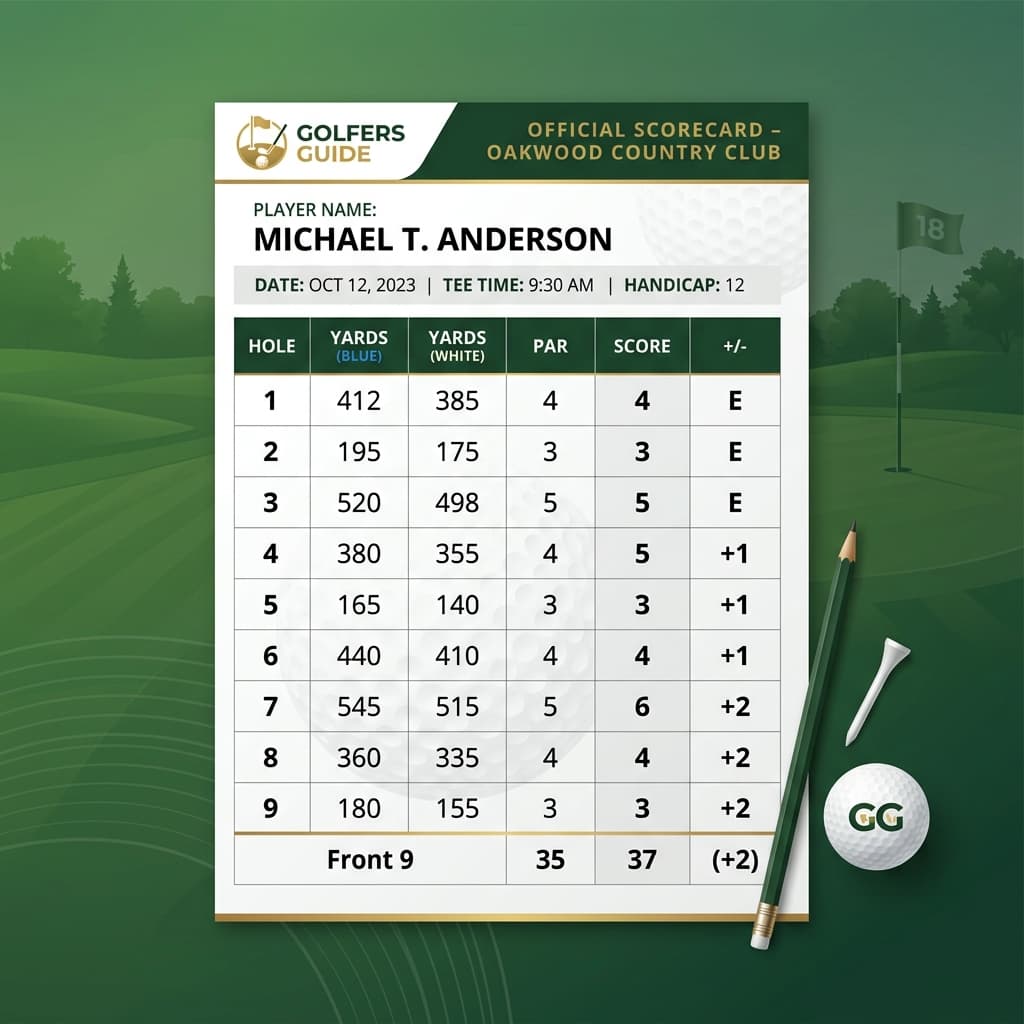
Filling in a golf scorecard sounds simple until you're standing at the 1st tee realising you're not sure whether you write your gross score or net score, who signs what, and what happens if you make a mistake.
This guide covers everything. Stroke play and Stableford. Gross and net. Handicap strokes. Signing off. What happens when something goes wrong.
What a golf scorecard contains
A standard club competition scorecard has:
- Player name and Handicap Index / Course Handicap — filled in before the round
- Date and competition name
- 18 holes — each with a par, a stroke index (SI), and space for scores
- Out (holes 1–9) and In (holes 10–18) subtotals
- Gross total — your raw stroke count
- Net total — gross minus handicap (stroke play) or points total (Stableford)
- Marker's signature — the person keeping your score signs the card
- Player's signature — you sign to certify the card is correct
Most cards also have a column for a second player's score — scorecards are typically shared between two players in a group, each marking the other. For a guide to interpreting every section of a completed card, see how to read a golf scorecard.
Who keeps the score?
In a competition, your marker keeps your score. The marker is usually another player in your group — nominated before the round or assigned by the committee. You are responsible for the correctness of your score on each hole; your marker verifies it by signing at the end.
In practice: your marker writes down your score on each hole as you go. You should verbally confirm the score after each hole — "that's a 5, correct?" — before moving on. Disputes are much harder to resolve once you've moved to the next tee.
Stroke play: what to write
In stroke play, record the gross score on each hole — the actual number of strokes you took, including any penalty strokes.
Example: On a par-4, you drive into the rough, chip out, hit the green in 3, two-putt. That's 5 gross. Write 5.
Penalty strokes count: Lost ball (Rule 18.2): stroke and distance — count your original stroke, add a penalty stroke, and count from the new position. A 5 with a lost ball where you played 3-from-the-tee-under-penalty, then two more strokes on the green = stroke total is 5.
Net double bogey cap: For WHS handicap purposes, scores above net double bogey (par + 2 + handicap strokes received on the hole) are capped in the calculation — but you still write your actual gross score on the card. The system applies the cap automatically when processing the score.
The handicap column in stroke play
Many scorecards have a "Net" column. This is where your gross score minus handicap strokes for that hole goes. But the critical rule is:
Write your gross score in the score column. Net calculation is secondary.
If you sign for a gross score lower than you actually made, you are disqualified — even if it was an innocent mistake. If you sign for a score higher than you actually made, that higher score stands. The rule is asymmetric: write the true gross score, always.
Stableford: what to write
In Stableford, your marker records your gross score on the card — not your Stableford points. The Stableford points are calculated by the committee when the card is returned. Your job is to write the correct gross score. For a full breakdown of the point values for birdie, par, bogey, and beyond, see golf scoring terms explained.
However: most players also note their Stableford points hole by hole for their own running total. This is unofficial and not what the committee uses — but it helps you track how the round is going.
Picking up in Stableford
If you've taken enough strokes on a hole that you can no longer score any Stableford points, you may pick up your ball without holing out. On the scorecard, many clubs ask you to mark this with an "X" or leave the score blank. Check your club's specific convention.
Important: if you pick up, that hole scores 0 points. If you hadn't picked up and holed out for a bad score, it would still score 0 points. Picking up doesn't cost you extra.
How handicap strokes work on the card
Your Course Handicap tells you how many strokes you receive across the round. These strokes are distributed across holes based on Stroke Index (SI) — printed on every scorecard.
The SI ranks holes from 1 (hardest) to 18 (easiest) based on how difficult they are for a bogey-standard player. If your Course Handicap is 12, you receive one stroke on the 12 hardest holes (SI 1–12). If your Course Handicap is 20, you receive one stroke on all 18 holes plus a second stroke on the two hardest holes (SI 1 and 2).
Practical example: You have a Course Handicap of 14. On a hole with SI 10, you receive one stroke. Your gross score is 5 (a bogey on a par-4). Your net score is 4 — effectively a net par. In Stableford, a net par scores 2 points.
On a hole with SI 18 (the easiest hole), you receive no stroke. A gross 5 on that par-4 is a net 5 — a net bogey, scoring 1 Stableford point.
Signing the card
At the end of the round, two signatures are required:
Marker's signature: The marker certifies that the gross scores written on the card are correct. The marker is not responsible for the handicap or Stableford point calculation — only the hole-by-hole gross scores.
Player's signature: You certify that the gross scores are correct and that your Handicap Index/Course Handicap is correctly declared.
The golden rule: Once you've submitted a signed card to the committee, the scores are final. You cannot return to correct a score — even if a mistake is immediately spotted. If the signed score is lower than actual, you are disqualified. If higher, the higher score stands.
Common mistakes and how to avoid them
Writing the wrong hole's score: At the end of a hole, confirm the score verbally with your marker before moving on. A disputed score at the end of a round, when memories are unreliable, is difficult to resolve.
Forgetting penalty strokes: Penalty strokes are easy to forget in the moment. Agree with your playing partners when a penalty applies and note it immediately on the card — don't leave it until the next tee.
Signing before checking: Take 60 seconds before signing to check each hole's score. Signing an incorrect card — even unintentionally — has consequences.
Incorrect handicap declared: Your Course Handicap should be calculated before the round and declared correctly. Using a lower handicap than you're entitled to is fine (you're playing off a higher standard). Using a higher handicap is a disqualification if discovered.
Marker not signing: Both signatures are required. A card with only one signature may be rejected by the committee.
Submitting the card
At most clubs, you hand the signed card to the committee representative or put it in the designated box near the clubhouse. For WHS purposes, the score must also be entered into the national handicap system — either by the club's competition secretary or directly by the player in the app.
For more detail on what counts as a qualifying round for handicap purposes, see the scorecard rules guide.
Frequently asked questions
My marker wrote the wrong score on one hole. Can we correct it? Yes — before the card is signed and submitted. Cross out the incorrect score, write the correct score, and both player and marker initial the correction. Once the card is submitted to the committee, corrections are not permitted.
Do I need to write my Stableford points on the card? No. Only gross scores are required. Stableford points are calculated from the gross scores and your Course Handicap after submission.
What if I'm not sure what score I took? Ask your playing partners — they were watching. If there's genuine uncertainty, the highest credible number is safest. Signing for a lower score than you actually made leads to disqualification; signing for a higher score means the higher score stands (not ideal, but not a disqualification).
Can I sign my own card as my own marker? No. The marker and player must be different people. Solo rounds are generally not eligible for competition submission anyway.
What happens if no one in my group knows the rules and we play a hole wrong? If a rules error is not corrected before the card is submitted, the result generally stands unless it involves a serious breach. The Rules of Golf apply whether or not players know them — but a committee may have discretion in some cases. When in doubt, play two balls (Rule 20.1c in stroke play) and ask the committee after the round.