The Problem: Ball on the Concrete
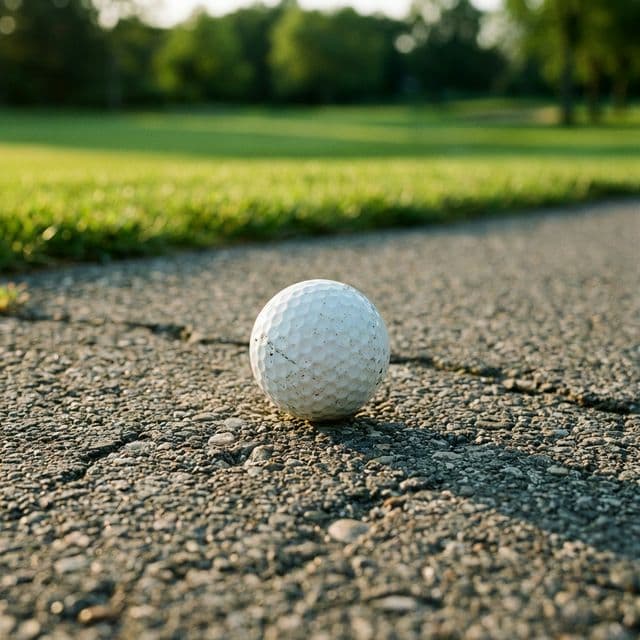
Perfect drive... bad bounce. Your ball sits right in the middle of the cart path. Do you have to scratch up your irons? Absolutely not.
Paved cart paths are considered Immovable Obstructions under Rule 16.1. You are entitled to free relief (no penalty).
Common Mistakes When Taking Relief
- Picking the most convenient spot, not the nearest. The "Reference Point" is the nearest spot where the path no longer interferes — even if it's behind a tree.
- Forgetting that stance matters. If you're a lefty, your reference point will be different from a righty, because your natural swing position is different.
- Measuring more than one club-length. The relief area is exactly one club-length (usually your driver) from the reference point.
How to Do It Right (Rule 16.1)
- Identify Reference Point: Find the nearest spot off the path where the path no longer interferes with your stance or swing. Not the "nicest" spot, but the nearest.
- Measure Relief Area: From that point, you have one club-length (usually your driver) to measure a drop zone.
- Drop the Ball: From knee height. The ball must stay within that relief area.
Warning! Sometimes the nearest point requires you to drop in a bush or behind a tree. In that case, playing from the path might actually be your best option! Always evaluate before picking up your ball.
Which Side of the Path Do You Drop On?
A question that catches players mid-round: can you choose which side of the cart path to take relief from? No — the rules give you no preference. You must drop at the nearest point of complete relief, whichever side of the path geometry dictates. If that nearest point puts you in light rough on the right, that is your reference point, even if a drop to the left would give you a cleaner line to the flag.
The key is that "nearest" is measured using your full address position — ball lie, intended stance, and intended swing arc — not just where the ball sits. Stand behind your ball, simulate your natural setup, and the correct reference point usually becomes clear before you ever mark the ball.
When Your Stance Is on the Path — But the Ball Isn't
Relief isn't limited to balls resting on concrete. If your ball settles in the rough just beside the cart path but a normal stance forces you to plant one or both feet on the surface, you still qualify for free relief under Rule 16.1. The procedure is identical: locate the nearest reference point where both the lie and your area of intended stance are fully clear of the path, measure one club-length from that point, and drop from knee height.
This is one of the most commonly misplayed situations on a golf course. Many players assume the ball must physically sit on the path to trigger relief — it doesn't. Any interference with your area of intended stance or swing is sufficient. Don't concede a penalty stroke the Rules never required you to pay.
Once you are comfortable with cart-path drops, the same Rule 16.1 reasoning applies to every immovable obstruction — sprinkler heads, control boxes, drain covers. Knowing how to choose a shot that creates sprinkler interference and trades a bare-dirt lie for perfect turf is one of the most underused legal advantages in amateur golf.