Ground Under Repair (GUR) in Golf
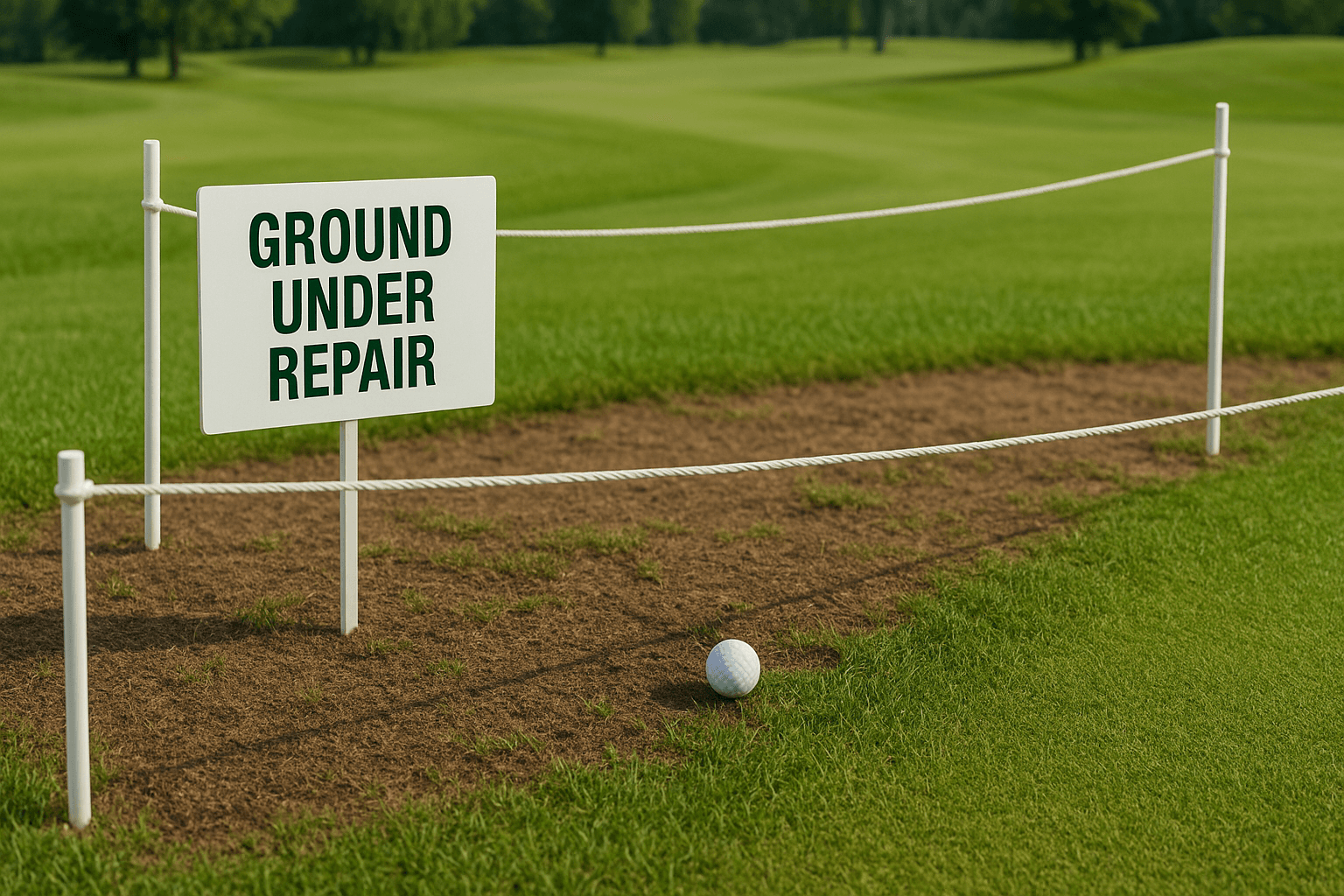
Ground under repair (GUR) is any area marked by the course committee as temporarily off-limits, usually identified by white lines or signs, and you get free relief when it interferes with your ball, stance, or swing (Rule 16.1). Relief is optional unless the committee makes it mandatory, and you drop within one club-length of the nearest point of complete relief without penalty.
What is ground under repair (GUR)?
Ground under repair (GUR) is any part of the course being repaired or designated as temporarily off-limits by the course committee. It is normally identified by:
- White paint markings on the ground (painted line or area)
- Signs or notices on the course indicating "GUR" or "Ground Under Repair"
- Material piled for removal (sand, soil, cut branches), even if unmarked, if it's clear the course will remove it
Tree bark chips, natural roots, and terrain divisions caused by normal use are NOT GUR unless specifically marked as such.
When are you entitled to relief?
You are entitled to free relief when ground under repair interferes with:
- Your ball (it rests inside or on the GUR area)
- Your stance (your feet would be inside the GUR for the stroke)
- Your swing area (the club would pass through the GUR during the swing)
If the GUR is only on your line of play without affecting stance or swing, you are not entitled to relief off the green (same as casual water and immovable obstructions).
Is relief mandatory?
Not always. Taking relief from GUR is generally optional: you can choose to play the ball as it lies from within the GUR if you prefer (at the risk of a poor stance or lie).
Exception: if the course committee has designated the GUR as a mandatory exclusion zone (play must be avoided), then you are required to take relief. This restriction is usually indicated in the course's local conditions sheet.
How to take relief
-
Find the Nearest Point of Complete Relief (NPCR): the closest point where there is no longer any GUR interference, not nearer the hole, in the same playing area.
-
Drop area: 1 club length from that point.
-
Drop from knee height within the area.
-
If the ball rolls outside, drop again.
GUR in a bunker
If your ball is in GUR inside a bunker:
- Relief within the bunker (no penalty): the NPCR within the bunker.
- Relief outside the bunker (1-stroke penalty): on a line going back from the hole through the ball position, outside the bunker.
Common cases
Exposed tree roots marked as GUR: entitled to relief if they interfere with stance or swing.
Seeding area or new planting marked with white paint: typical GUR. Entitled to relief even if the ground looks dry and normal.
Unmarked ant hill or mole run: may qualify as abnormal course conditions if the course has designated it, but if there are no markings and it's not a protected animal hole, it's not automatically GUR.
Penalty
None for taking correct relief. If you play from GUR marked as mandatory without taking relief: 2 strokes in strokeplay / loss of hole in matchplay.
Tactical advice
When the GUR entitles you to drop but the NPCR leaves you in a similar or worse position, it's sometimes better to play from the GUR directly. Evaluate the lie and position: a ball on disturbed earth with a good lie can be preferable to a drop in thick rough.
GUR on the putting green
When ground under repair is on the putting green, the relief procedure changes. You must find the nearest point of complete relief that is on the putting green and not nearer the hole. If no such point exists on the green, you use the nearest point off the green that avoids the GUR. You then place (not drop) the ball at that spot. This is different from GUR elsewhere on the course where you drop within one club-length (Rule 16.1d).
Keep reading: penalty area
Frequently asked questions
What counts as ground under repair on the course?
Ground under repair includes any area marked with white paint, signs, or material piled for removal like sand or branches, but not natural features like tree roots or bare patches unless the committee specifically marks them (Rule 16.1).
Do I have to take relief if my ball is in GUR?
No, relief from GUR is optional unless the committee has declared it a mandatory exclusion zone in the local rules, in which case you must take relief or incur a two-stroke penalty in stroke play (Rule 16.1).
How do I find the nearest point of complete relief from GUR?
Find the closest spot where the GUR no longer interferes with your ball, stance, and swing, that is not nearer the hole and stays in the same area of the course, then drop within one club-length of that point (Rule 16.1b).
What if my ball is in GUR inside a bunker?
You can take free relief inside the bunker at the nearest point of complete relief, or take a one-stroke penalty and drop outside the bunker on a line back from the hole through the ball (Rule 16.1c).
Can I get relief if GUR is only on my line of play but not my stance or swing?
No, interference only on your line of play does not entitle you to free relief from GUR off the putting green, just like with casual water or immovable obstructions (Rule 16.1a).
What if my ball is lost in ground under repair?
If it is known or virtually certain your ball is in GUR (e.g., you saw it enter a marked area), you take free relief under Rule 16.1e using the estimated point where the ball last crossed the edge. If it is not known or virtually certain, you must take stroke-and-distance relief.
How does relief work when GUR is on the putting green?
You find the nearest point of complete relief on the putting green that is not nearer the hole. If no such point exists on the green, you use the nearest point off the green. You then place the ball at that spot — no drop, no club-length (Rule 16.1d).
Is an unmarked animal hole considered ground under repair?
No. Animal holes (like rabbit or mole runs) are abnormal course conditions under Rule 16.1, but they are not GUR unless the committee specifically marks them as such. You still get free relief from animal holes, but the definition and marking requirements differ.